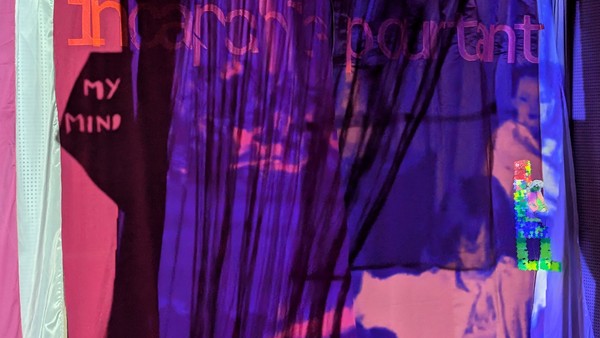
With a background in performing arts, Agathe Mercat has, in recent years, developed a personal artistic practice centred on the techniques of sewing and digital embroidery. Her project, ‘Koodre comme on parle’ (Sew like we speak), combines traditional craftsmanship with an aesthetic exploration that expresses social and political issues. In parallel, she is developing art and cultural education projects, giving shape to collective artworks and a performance combining textiles and digital projection.
The project ‘Sous les plis’ (Beneath The Folds)
Agathe Mercat spent a month experimenting in the white studio at L’Abri in Geneva, projecting colour to her embroidered fabrics. This residency follows two years of very short residencies, each culminating in a performance in which play took precedence over the creation of visual artwork. Yet it is indeed a living work that the artist ultimately seeks to create – a work that reflects the complexity of traumatic memory and the simplistic ways in which it is portrayed in the media. Here, traumatic memory refers to the brain’s protective response following a shock, with shock referring specifically to incest.
At a time when debates surrounding the statute of limitations and freedom of speech are particularly topical, the artist questions the nature of these discussions and sets out to visually explore the materiality of language. Through three texts addressing trauma, anger and the memory of trauma respectively, she focuses on the relationship she wishes to establish with her audience.
During her residency, she regularly attends the theatre and notices that expressions of female anger no longer provoke the same sense of shock. How, then, can she make words resonate, giving them depth and significance?
Her first work centres on embroidered curtains bearing a phrase that is dear to her: "I am part of that army, yet incapable of raising the banner”. From this sentence, she derives a series of micro-poems, revealed through changes in the colours of the curtains: “I am here”, “I am from here”, “I am armed here”, “I am here, armed”. The order of the words alters their meaning, temporality and tension.
After spending two weeks applying colour to the curtains—which had already been embroidered using a digital projector—Agathe Mercat returned to Rennes, enriched by this initial work. But another discovery, again related to the materiality of language, awaited her in Geneva. As she left a performance, she realised that expressions of anger are complex, and that female victims must continually expose themselves in order to be heard. Agathe Mercat’s paradox lies in her desire to avoid exposing her own trauma, while at the same time hoping that others will be willing to listen – or not.
She then imagines projecting various texts upside down onto the curtains, requiring the audience’s active involvement – almost like a dance – to read them. By positioning a piece of fabric in the opposite direction to the projection, they can reveal the text the right way up. In this way, a new meaning emerges from the phrase: "yet unable to raise the banner". Here, it is others who raise the banners to make her words visible.
Meeting Noel Apitta
At L’Abri-Genève, she also met Noel Apitta, who was in residence at the same time. He later travelled to Rennes to spend some time with her and help with the projection, and continues to brainstorm future joint projects with her to this day.